|

The 2007 Whittier Mill Village Tour of Homes will be held on September 9! Get more details now!
Served
by the Southern Railroad (several trains a day) and an electric
streetcar line running every thirty minutes, the mill and its village
nestled in a small valley near the Chattahoochee River. Construction
began in May 1895 and was completed in less than a year at a total
cost of $180,000. Less than a quarter mile away was the Chattahoochee
Brick Company, and a March 6, 1895 letter from that firm's vice
president G. W. Parrott outlined and confirmed the financial arrangement
between his corporation and Whittier Cotton Mills. The brick company
sold thirty acres along the river and their manager's existing brick
cottage and would construct a 40,000 square foot cotton mill, warehouse,
and a storehouse of "the very finest hard brick" as well
as thirty frame cottages for the operatives. The mill owners would
apply half of the equipment from their existing mills in Massachusetts
and half would be new. Chattahoochee Brick received $2,500 in cash
and $50,000 in stock.
The mill company
was named after the Whittier family of Massachusetts, which had
started the business in Lowell. The actual owners, however, were
Paul Butler, son of Civil War general Benjamin Butler, and several
other prominent capitalists. Nevertheless, the Whittier family provided
the major officers, including president Helen Whittier and treasurer
Nelson Whittier. According to newspaper reports, it was Helen Whittier
who selected the site for the southern branch of the ten mill system
and who officially threw the switch to open the factory in 1896.
Miss Whittier had come to Atlanta prior to the 1895 Cotton States
and International Exposition and was obviously attracted to the
area for the firm's southern expansion. Her nephew Walter R. B.
Whittier was installed as the manager, a job he would retain until
1936.
A special feature
in the Atlanta Journal in July 1896 (six months after the mill had
been operating) was subtitled "Quite a community itself/The
Operatives Colonized in Comfortable Cottages -- Built by Capitalists
of New England." In a typical Victorian prose, the writer stated:
"One of the most picturesque places in the vicinity of Atlanta
is Whittier Mills. . . . The houses of the operatives are built
around the brow of the hill in a semi-circular shape. . . [that]
resembles a half-moon. . . . The greatest number of these houses
face the mill and are built of the best material with terraced yards
and plenty of green grass, some of the more thrifty of the occupants
already having roses planted and growing. Altogether they present
an appearance of thrift and care not usually seen among people of
this class." Guarding over the workers was manager Walter "Boss"
Whittier in a large, brick house named "Hedgerows" on
a nearby hill, and superintendent W. H. Salmon, also living on the
property. The homes of these two men were heated with steam from
the plant.
Other than
jobs, which started in 1896 at one dollar a day, the mill owners,
over the years, provided a settlement house, store, a school building
with space for church services, and a golf course. In the east half
of the mill store were dry goods, groceries were located in the
west half and the Chattahoochee post office occupied the northwest
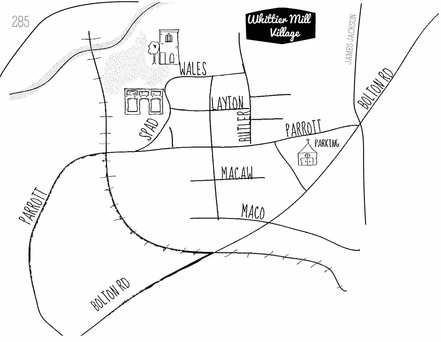
corner. Directly across Parrott Avenue from the company store is
what was and is known as the "ark" which housed the barber
shop, a shoe shop, a pharmacy, and the men's showers.
Housing
was rented from the mill and paid for by the room. Most units were
duplexes and were built with locks on both sides of the doors to
each room so the interiors could be easily reconfigured when families
needed more space. At $.50 per room, $1.50 per week, or $6.00 per
four week month, the price included all maintenance and utilities.
The mill kept the houses painted and the grass cut, provided water
and electricity, and made all plumbing and electrical repairs. The
original houses had wells for water, but when there was a mill expansion
in 1926, the new houses had running water. The 1926 housing is distinguished
by less steeply pitched roofs than the original dwellings and was
designed by the Boston architectural firm of Parsons and Wait. Paul
and Sid Whittier (sons of W. R. B. Whittier) oversaw the construction,
which was of "Common Southern Pine," fireplaces and chimneys
of Chattahoochee brick, and sited on pier foundations. The streets
were unpaved, but rear alleys helped provide good drainage and the
lots were smaller for easier upkeep. To this day, the 1926 construction
is still called "New Village" by long time area residents.
That some "outside"
help was needed, however, is reflected in W. R. B. Whittier's 1910
request that the Atlanta Sheltering Arms Association of Day Nurseries
set up a settlement in the village. In addition to the nursery,
there were kindergarten classes, night school for adults, clubs
for boys and girls, and mothers' meetings with a social worker.
A physician held free clinics twice weekly, and a brass band was
organized for the young men, who performed in a bandstand located
north of Parrott Avenue. The settlement house was in a large, three
story building at the southeast corner of Parrott and Whittier Avenues
(based on the 1911 Sanborn Fire Insurance Map), but was dismantled
in 1926 with the waning of the settlement house movement in the
United States during that decade. Sections of the settlement house
were used to construct other houses in the expansion of the village
that year.
Despite the
many amenities provided by the mill owners, life for the workers
was not easy even if it was a step up from rural or mountain poverty.
Sid Whittier, the last member of his family to run the business,
showed why this was when he stated that even with the low pay, ".
. . there were hundreds of people for every job and none of them
had ever worked in a factory before." The 1900 census lists
635 people working at Whittier Cotton Mills including 211 weavers,
135 spinners, 60 spoolers, 48 dolphers, 29 carders, 23 speeders,
and 20 drawers. Many of the dolphers, weavers, and spinners were
children as young as seven or nine years. The failure of southern
states like Georgia to pass compulsory school attendance laws made
it possible to employ children and helped the southern mills to
have profits of twenty to seventy-five percent while their counterparts
in New England might be actually losing money. Another factor in
such profits was long hours. During its first decades, Whittier
Mills ran seven days a week with two shifts, midnight to noon and
noon to midnight. Six day work weeks were standard. According to
I. A. Newby in Plain Folk in the New South, mill villages were often
plagued with alcoholism and violence partially as a result of the
hard conditions. He recounts numerous incidents throughout the South
and one from Whittier Mills in 1905 when two male youths who had
been drinking assaulted two young girls on a public street. All
were workers at the mill. This and other similar incidents undoubtedly
brought about the establishment of the settlement house in 1910,
but it is difficult to imagine how the workers could realistically
be expected to take advantage of its programs when whole families
worked such long hours.
These workers
or operatives primarily produced cotton yarn, ranging in size from
"twos," used for window cord, to "forties,"
the finest of cotton filaments. "Softbacks" for gloves
and mittens, braiders' yarn, druggists' twine, and wrappings for
hose were also manufactured. Mississippi delta cotton was used for
thread and California cotton was used for yarn. Yarn-wrapped water
hose used for firehoses was the mills' specialty. The use of cotton
fiber to make flexible firehoses had been developed by Paul Butler
and Nelson Whittier prior to 1895 and the business had a virtual
monopoly on the production due to patents on the circular loom and
twister machinery these two men had developed. It was this part
of the Whittier Mills production which was moved to Georgia with
the opening of the new southern branch.
Nevertheless,
the mills' wares changed with the times. In 1914 experiments with
"mineral wool" or asbestos were recorded and in the late
1920s blue denim was sold to the United States penitentiary in Atlanta.
During World War II, the mills made cloth for sandbags for the federal
government. At other times, Whittier Mills produced corduroy cloth,
garden hosing, and even synthetic cloth. In September 1926 the trade
journal Cotton reported that the Silver Lake Company had applied
for a charter to produce cordage at Whittier Mills in what was now
called the suburb of Chattahoochee. It was this expansion of the
mill by 65,000 square feet which brought about the already mentioned
addition to the mill housing.
The 1930s proved
a particularly difficult time for Whittier Mills and its workers.
The Whittiers had had a virtual monopoly on firehose yarn production
in the South until the depression when Callaway Mills hired a key
worker, who stated Sid Whittier, ". . . took a complete set
of yarn samples and the 'know-how'" with him. Bibb Manufacturing
later hired knowledgeable personnel from Callaway, and three southern
mills began to compete for the lucrative firehose business. Again
according to Sid Whittier, ". . . the last to pirate his way
in had a cost advantage because he comes in with more modern machinery."
To earn extra money during the Depression, millworkers cut pieces
for Ideal American Jigsaw puzzles in the evenings.
The loss of
the monopoly and the depression ended the mills' expansion. Permanent
lay-offs and short-term strikes occurred at Whittier Mills, which
had begun to lose money on its Georgia operation. In 1934, the year
of the General Textile Strike throughout the country in which so
many southern millworkers participated, "Boss" Whittier
left the operation. J. J. Scott of Scottdale Mills near Decatur
became general manager. Scott divided his time between his own mills
and their competition at Whittier Mills in the town of Chattahoochee.
Scott put the mill back into the black and in 1936 placed Hanford
Sams in the manager's position of both his mills. Sams eventually
became vice president of the Whittier Mills board of directors under
president Scott, who had taken over that position from Sid Whittier
in 1936.
During
the 1940s, the new management and wartime contracts brought renewed
economic stability to the mill and the village. The employees' newsletter,
Whittier Mills & Silver Lake News, reported on the prowess of
the company baseball team with detailed accounts of winning seasons,
playing against Clarkdale Thread Mill and Celanese (of Rome), and
in 1948, the construction of new bleachers for the fans. That year
the Osborne family were the big stars: the father, "Tiny,"
was once a major league player for Chicago and Brooklyn in the National
League; "Jeter," one of his seven children, played in
the Southern League for the New Orleans Pelicans; and another son,
"Bottles" played for Rochester (AAA ball) and Birmingham
in the Southern Association. In 1949, the trolley from Atlanta,
filled with free riders for the occasion, made its last run to Chattahoochee.
Major changes
occurred, however, in the 1950s. In 1952 the City of Atlanta annexed
Chattahoochee, an unincorporated township since its foundation.
It was also in this decade that J. P. Stevens sold Whittier Mills
to Scott Dale Industries. Shortly after the mills' sale in 1954,
the new owners began selling the mill houses to the tenants starting
at $2,000. Butler Way was extended to occupy the old baseball grounds
and several of the houses were moved there to create more equitably
sized lots.
By mid-1971,
Whittier Mills has closed for good following a decade of increasing
competition from cheap imports. Company officials cited the problem
as ". . . the accelerating flood of imports from low wage countries
into our textile market. Added to this problem is the shortage of
textile workers in this area." Although it was reported at
the time that low unemployment figures for Atlanta meant the workers
would probably find new jobs quickly, newspaper reports later that
year stated that still unemployed workers from Whittier Mills would
be eligible for extended benefits from the federal government because
job loss was deemed the result of unfair trade practices.
For the
next two decades, the mill buildings went unused. Several were burned
by arsonists in 1986 and the owners proposed to turn the site into
a landfill in 1980. Over the protests of local residents, the remaining
structures were demolished in 1988 by Victorian Artifacts, Inc.,
which valued the massive heart-of-pine timbers and the antique bricks.
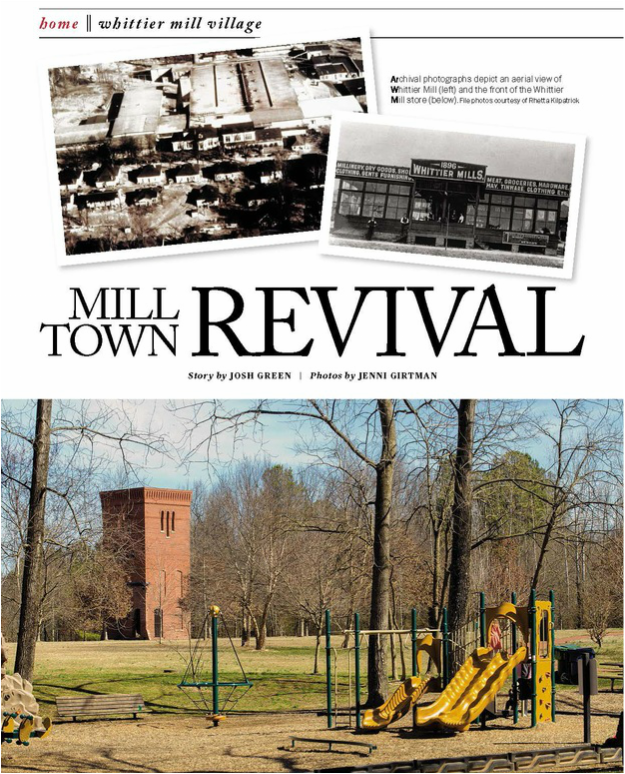
The original mill tower which housed offices and a water tank for
fire protection still remains. Meanwhile, a small investment group
began to renovate the area's housing for resale. A 1991 article
in the Atlanta Journal/Constitution Homefinder section indicated
that the renovation work had been successful with the old mill houses
selling for up to $75,000. One of the "amenities" cited
in the article was that residents were seeking historic status.
Back
to Top
|